
Tidal Workshop: Mastering the Flow
There is a distinct kind of panic that sets in when a pressure gauge begins to violently shudder in the red zone, accompanied by the ominous sound of rushing water beneath the floorboards. This is the precise emotional frequency at which Tidal Workshop operates. Developed as a co-op engineering puzzle game, it places you and a partner in the increasingly damp boots of two maintenance workers tasked with managing a complex network of valves, pressure pipes, and rising tides in a dilapidated coastal facility. It is a game about communication, spatial reasoning, and the frantic coordination of tools, delivering an experience that is as intellectually demanding as it is inherently chaotic. The premise is simple: keep the workshop from flooding by routing water through archaic industrial mechanisms. The execution, however, requires synchronisation that will test robust friendships.
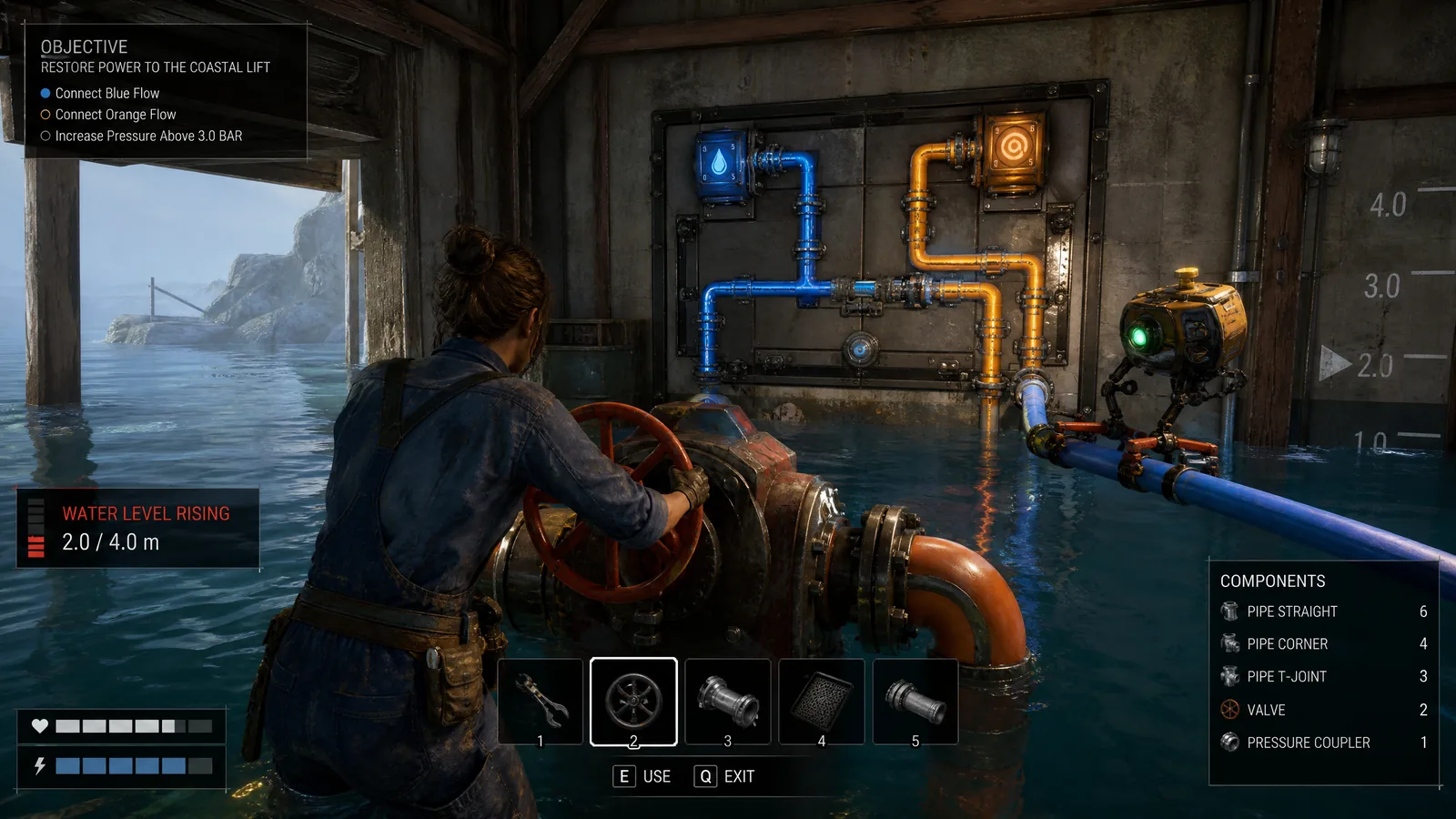
At the heart of the experience lies the intricate simulation of pressure networks. The workshop is a labyrinth of interconnected pipes, boilers, and release valves, governed by a robust fluid dynamics system. Every action has an immediate reaction. Opening a primary intake valve might alleviate strain on a secondary boiler, but it could simultaneously redirect high-pressure water towards a fragile section of piping your partner is attempting to repair. The game demands that you understand the immediate function of each component and anticipate the cascading effects of your adjustments. This systemic depth transforms isolated mini-games into a cohesive mechanical ecosystem. You are not just solving puzzles; you are actively managing a volatile machine.
The Art of Tool Coordination
Survival in Tidal Workshop relies heavily on effective tool coordination. The characters are equipped with an essential array of implements: heavy-duty wrenches for turning stubborn valves, welding torches for sealing micro-fractures, and pressure monitors for diagnosing unseen blockages. The catch is that tools cannot be duplicated, and passing them between players requires physical proximity and precious seconds. This design brilliantly forces players to specialise on the fly and communicate needs with absolute clarity. You might find yourself trapped on a precarious catwalk, desperately needing the welding torch to prevent a blowout, while your partner is submerged waist-deep, using that same torch to repair a critical pump. The ensuing negotiations over resource allocation are frantic and central to the game's charm.
The necessity for clear co-op communication cannot be overstated. Tidal Workshop eschews complex user interfaces in favour of diegetic information. If you want to know the pressure level in the eastern wing, you must physically look at the gauge, or yell at your partner to check it. This reliance on verbal updates creates a beautiful symphony of frantic instructions. Miscommunications are frequent and disastrous, but they are the source of the game's most memorable moments. When a plan comes together, and you successfully execute a complex sequence of valve adjustments with split-second timing, the sense of shared accomplishment is profoundly satisfying.
One of the game's most commendable achievements is its readable failure states. When things go wrong, it is rarely a mystery as to why. A burst pipe is preceded by visual bulging and a distinct auditory groan; a failing boiler emits a terrifying whistle before erupting in scalding steam. These clear telegraphs allow players to trace their mistakes back to a specific decision. Instead of feeling cheated by an arbitrary game over screen, you are presented with a tangible mechanical failure that you can analyse and correct. This readability is crucial for maintaining motivation, transforming failures into valuable learning experiences.
Escalation and Solo Endeavours
The puzzle escalation in Tidal Workshop is masterfully paced. The initial levels serve as a gentle introduction to the core mechanics, allowing players to familiarise themselves with basic water pressure properties and tool usage. As you progress deeper, the complexity ramps up significantly. You will encounter corrosive fluids requiring specialised containment protocols, automated systems that override manual inputs, and environmental hazards that restrict movement. The rising water level acts as a constant threat, gradually reducing available workspace and forcing rapid, high-stakes decisions. The difficulty curve is steep but fair, consistently challenging you to apply accumulated knowledge in increasingly stressful situations.
While designed from the ground up for cooperative play, the game offers a dedicated solo mode. The player assumes control of a single engineer accompanied by an automated robotic assistant. You can issue basic commands to the drone, such as "hold this valve" or "bring me the wrench," allowing you to execute multi-step processes. The solo experience is functional and retains core puzzle-solving satisfaction, but it inevitably lacks the frantic energy and communication-based hilarity of co-op. Managing the drone can occasionally feel more like a chore than a partnership, particularly in demanding levels where split-second timing is paramount. It is a commendable inclusion for those without a co-op partner, but undoubtedly the secondary way to play.
The rising water level acts as a constant, looming threat, gradually reducing your available workspace and forcing you to make rapid, high-stakes decisions.
Performance and Final Verdict
From a technical standpoint, Tidal Workshop performs admirably. The fluid simulation, the backbone of the experience, is visually impressive and mechanically robust, maintaining a consistent framerate even when the screen is filled with rushing water. The industrial aesthetic is well-realised, with detailed textures and evocative lighting that capture the damp atmosphere of the failing coastal facility. However, there are occasional instances of physics jitter when multiple objects interact in confined spaces, and the control scheme can feel slightly clunky when attempting precise actions in a hurry. These issues are relatively minor and rarely detract from the overall experience.
The pacing of the campaign is generally excellent, offering a satisfying blend of intense scenarios and quieter moments of contemplative puzzle-solving. The downtime between crises allows players to catch their breath and reassess strategies. The controls are intuitive, mapping essential functions to accessible inputs that quickly become second nature. The game's reliance on physical interactions rather than abstract menus enhances the sense of immersion, making every turn of a wrench feel weighty and significant.
Ultimately, Tidal Workshop is a triumph of cooperative game design. It takes a unique premise and executes it with mechanical depth, visual flair, and a keen understanding of what makes multiplayer gaming compelling. It is a game that will test your problem-solving skills, your ability to communicate under pressure, and your patience with your friends. While the solo mode is merely adequate and there are minor technical blemishes, the core cooperative experience is undeniably brilliant. It is ideally suited for players who enjoy complex systems, frantic coordination, and overcoming seemingly insurmountable odds through teamwork. With an impressive score of 8.3/10, it stands as a shining example of the genre.