
Breakwater Meridian: Tactical Hovercraft Racing at its Zenith
There is a distinct moment in every race of Breakwater Meridian where the chaotic roar of the storm seems to pause, leaving only the hum of your hovercraft's engine and the towering crest of an incoming rogue wave. In this high-stakes tactical hovercraft racer, survival and victory are inextricably linked to your ability to read the turbulent seas. Developed with an uncompromising vision for physics-driven arcade racing, the game demands far more than just holding down the accelerator. It is a masterful blend of environmental hazard management, precise boost economy, and ruthless lane positioning, set against some of the most visually arresting coastal storms ever rendered on modern hardware.
At its core, Breakwater Meridian relies on an intricate wave-reading mechanic that elevates it above traditional anti-gravity racers. The sea is not merely a dynamic backdrop; it is the track, the obstacle, and occasionally, your greatest ally. Swells rise and fall with unpredictable ferocity, forcing players to constantly adjust their trajectory. Hitting a wave at the correct angle grants a crucial burst of momentum, while misjudging the crest can result in a devastating loss of speed or a catastrophic flip. This system requires a profound level of focus, as you must scan the horizon for shifting water patterns while simultaneously fending off aggressive rival craft.
The Art of the Boost and Hull Integrity
Managing your hovercraft's systems is just as vital as navigating the treacherous waters. The boost economy in Breakwater Meridian is intimately tied to your vehicle's hull integrity, creating a brilliant risk-versus-reward dynamic. Boosting consumes energy that is otherwise used to maintain the structural integrity of your craft against the pounding waves and collisions with competitors. Deplete your reserves too eagerly on a straightaway, and a sudden broadside from a rival or a heavy landing off a wave could shatter your hull, ending your race prematurely. It is a delicate balancing act that punishes recklessness but generously rewards calculated aggression.
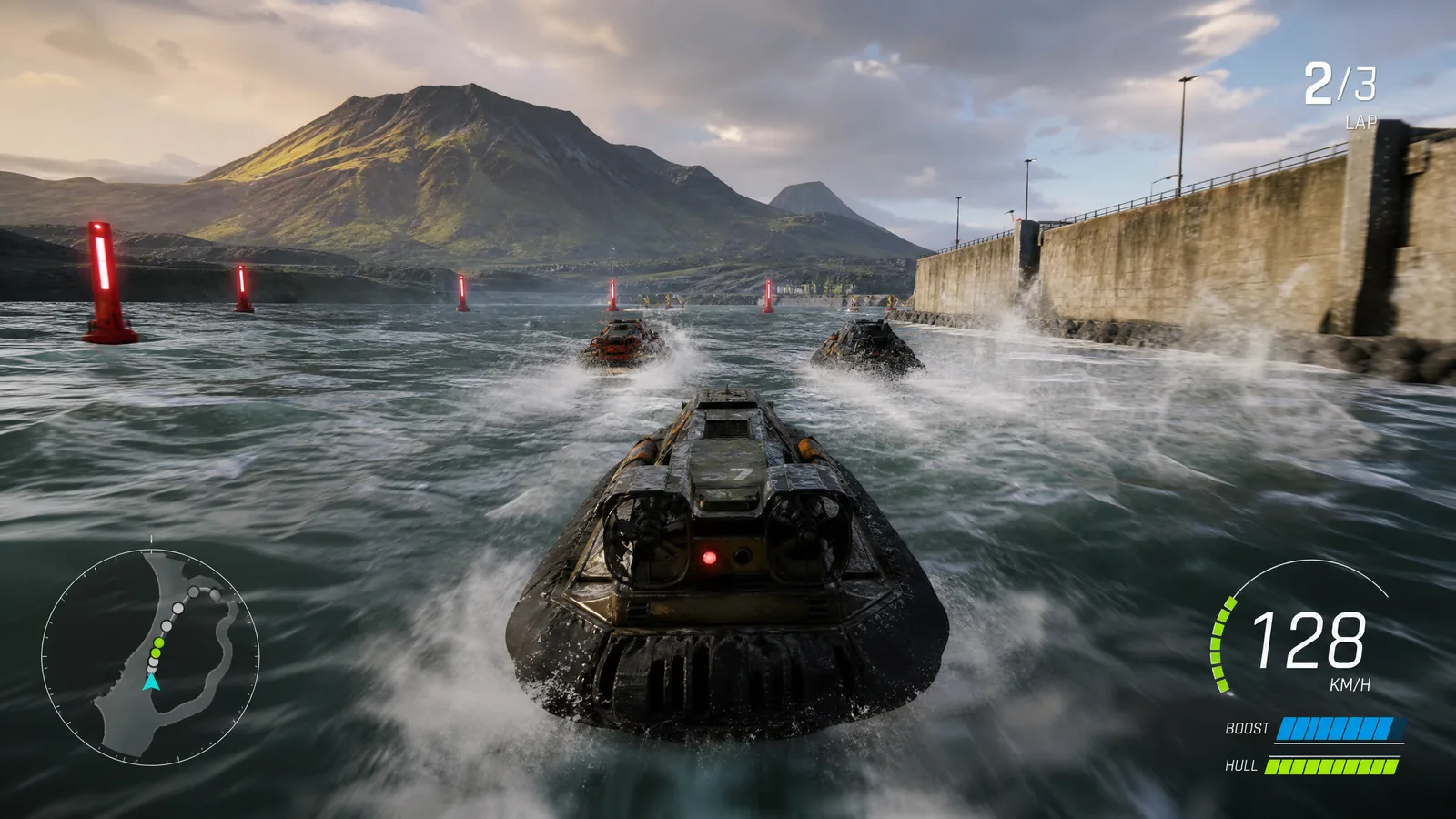
Tactical lane choices further complicate this balancing act. The tracks often feature towering concrete breakwaters, rusted naval hulks, and treacherous reef shallows. Hugging the breakwater might offer a sheltered, flatter racing line, but it is also heavily congested and leaves little room for evasive manoeuvres. Conversely, venturing out into the open swells provides more space to build up speed, but exposes you to the full wrath of the storm and rogue waves. Learning when to tuck into the sheltered lanes and when to brave the open water is a skill that separates the competent pilots from the true masters of the meridian.
The HUD plays a crucial role in feeding you this vital information without overwhelming the senses. It is a masterclass in minimalist design, projecting essential telemetry—such as hull stress, boost reserves, and incoming wave vectors—directly onto the canopy glass. This allows you to maintain your focus on the environment and the rival craft, which are designed with a brutalist, industrial aesthetic that perfectly complements the harshness of the storms. The visual feedback when a rival is drafting you, or when your hull is groaning under the immense pressure of a heavy landing, is incredibly visceral.
Mastering the Controls and PC Performance
When it comes to the controller feel, Breakwater Meridian shines brightly. The haptic feedback on modern gamepads is utilised to stunning effect, translating the shudder of the hull, the resistance of the water, and the sudden jolt of a collision directly into your hands. The analogue triggers provide nuanced control over the throttle, allowing you to feather the engine as you crest a wave, while the dual-stick setup enables independent control of steering and pitch. Pitching the nose of the hovercraft up or down is essential for surviving the largest swells, and the weighty, responsive controls make every successful manoeuvre feel earned.
On PC, the game is a technical marvel, though it demands respectable hardware to truly shine. The graphics settings offer a comprehensive suite of options to tailor the experience, but the fluid dynamics and volumetric storm effects are heavily CPU and GPU intensive. At maximum settings, the way the rain streaks across the camera, the lighting flashes through the churning storm clouds, and the water reacts to the sheer force of the hovercraft engines is nothing short of breathtaking. Fortunately, the developers have included robust upscaling support and granular tweaks for wave tessellation and particle density, ensuring that players on mid-range systems can still achieve the crucial 60 frames-per-second required for a responsive racing experience.
The sea in Breakwater Meridian is a relentless, calculating adversary. It does not simply provide a surface to race upon; it actively conspires to tear your vessel apart, demanding absolute respect and unwavering concentration.
Campaign Pacing and Final Verdict
The campaign pacing is another area where the game excels, offering a structured yet flexible progression system. You begin as a rookie pilot in the lower-tier coastal leagues, gradually earning credits to upgrade your hovercraft's engine, hull plating, and stabilisers. The difficulty curve is steep but fair, slowly introducing more severe weather conditions and more aggressive AI opponents. Each tournament feels like a distinct chapter, culminating in gruelling endurance races that test every skill you have acquired. While the narrative elements are sparse, delivered mostly through text briefings and atmospheric loading screens, they effectively contextualise the desperate, high-stakes nature of this futuristic motorsport.
Despite its many triumphs, Breakwater Meridian is not without its limitations. The sheer intensity of the races can be mentally exhausting, making it difficult to play in long sessions. The punishing nature of the hull integrity system may also alienate players looking for a more forgiving, traditional arcade racer. Furthermore, while the tracks are visually spectacular, the reliance on stormy coastal environments means there is a slight lack of visual variety in the later stages of the campaign. However, these are minor grievances in the face of what is otherwise a brilliantly executed concept.
Ultimately, Breakwater Meridian is a triumph of design and execution. It successfully marries the visceral thrill of high-speed racing with the tactical depth of a survival game. The wave-reading mechanics, combined with the punishing boost economy and spectacular storm visuals, create an experience that is both unique and immensely satisfying. It is a game tailored for those who crave a challenge, who want their racing games to demand precision, strategy, and a cool head under pressure. With a score of 9.2/10, it stands as a towering achievement in the genre, setting a new benchmark for tactical hovercraft racing.