
Aoraki Night Freight
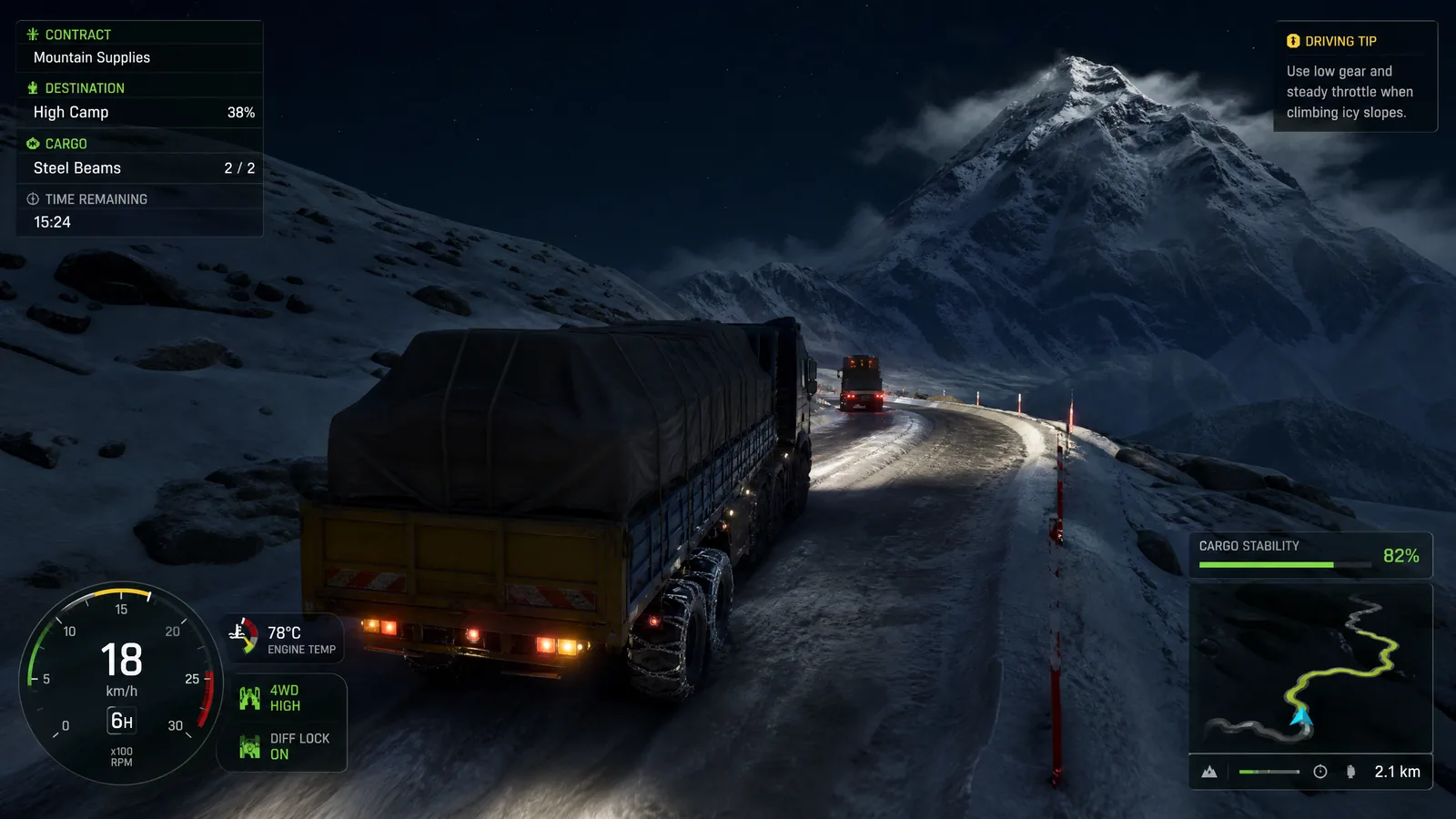
There’s a moment in Aoraki Night Freight where the world narrows to a single ribbon of ice-slick tarmac, your truck’s chains clanking underfoot and the headlights carving through a freight of falling snow. You climb a switchback beneath high mountains, a hulking trailer bowing under its load, and every metre feels earned. The opening tableau — a chained freight truck inching along a grey rope of road beneath ragged peaks — is the game in miniature: slow, precise, occasionally terrifying, and oddly beautiful. This is an alpine truck simulation that asks you to respect the elements as much as you respect the mechanics of haulage.
Aoraki doesn’t chase arcade thrills or cinematic heroics. It’s a simulation that trades spectacle for systems: traction, cargo stability, weather and route planning are the pillars that define each run. Pacing is deliberate — contracts are long, roads are longer — and the sense of progress is measured in kilometres and careful decisions rather than flashy unlocks. On PC and console alike, the game rewards patience and competence. There’s a meditative quality to barreling through a blizzard for hours, punctuated by tense bursts of technical driving when the road tightens and the trailer begins to yaw.
When the chains bite and the engine sings against the gradient, Aoraki makes you feel every decision, from which lane you choose to how you balance revs and gear.
Traction is the star system here. Snow and ice aren’t just visuals — they’re constantly changing variables that alter how your truck behaves. The physics model accounts for tyre compound, chain usage, temperature and gradient so that grip can be fleeting. You’ll find yourself feathering the throttle, selecting lower gears to use engine braking, and sometimes deliberately shifting a fraction too early to coax the wheels back into purchase. The game’s fidelity is impressive: lateral slip, tyre scrub and the subtle differences between studded and non-studded tyres all feed into a believable handling model. That said, the simulation occasionally tips into predictability at the extremes, where repeated situations produce similar outcomes, but on balance the traction model is granular enough to keep skilled players engaged.
Closely allied to traction is cargo stability. Loads are not static masses; they oscillate, shift and amplify the smallest mistakes. A poorly secured consignment will start to pendulum on tight bends, and trailers with high centres of gravity can become death traps on switchbacks. The game forces you to consider securement and balance before departure — double-checking lashing points, redistributing weight and sometimes accepting smaller, safer payloads to preserve roadability. The consequences for careless hauliers are real: jackknifing, damaged freight and expensive repairs put a meaningful dent in your bottom line, which ties neatly into the economy mechanics.
Route Planning, Weather and the Alpine Environment
Route planning is more than dotted lines on a map. Aoraki’s navigation system layers elevation, expected weather windows and rescue points into its planning tools, encouraging pre-trip reconnaissance. You’ll determine not just the fastest route but the safest: avoiding exposed ridgelines during a whiteout, or detouring to a staging area when avalanches are active. Weather is dynamic and punishing — blizzards can reduce visibility to metres, crosswinds buffet trailers, and freezing rain can glaze everything in treacherous sheen. The game’s weather systems are excellent at creating tension and shaping strategy; they also expose performance issues on older consoles where frame drops in heavy particle weather occasionally interfere with precision driving.
Cab feedback underpins immersion. The interior view is detailed, with accurate instrumentation and a pleasing soundtrack of engine churn, chain clatter and wind noise. The cab tools — mirrors, tachometer, supplementary gauges — are functional and provide essential information when external visibility is compromised. Haptic and force-feedback support is robust on PC wheels and the latest consoles: the wheel tells you when grip is lost, and controller rumble does a credible job translating tyre slip and trailer snatch. Keyboard and pad players are well supported, with configurable deadzones and sensitivity curves, but the game truly shines with a wheel and pedals combination where the fine gradations of throttle and steer feel rewarding.
Systems, Economy and Controls
The economy is pragmatic rather than punishing. Contracts scale in difficulty and reward, and you’ll balance risk against return regularly. Fuel consumption, maintenance and downtime are tangible costs that influence route choices and vehicle upgrades. Spending on better tyres, heavier chains and reinforced trailers becomes a strategic decision, not merely a cosmetic one. Progression is steady: you don’t need to grind hours to unlock meaningful equipment, but repeated successful runs are necessary to tackle the toughest alpine deliveries. Skill progression also matters — learning to manage a heavy, top-heavy load on a frozen descent is worth more than a fresh upgrade in many scenarios.
Controls are mostly excellent. Steering physics translate well to both wheel and controller input, and the game offers a wealth of customisation options for input devices. The inclusion of clutch and H-shifter support will please hardcore sim fans; vibration and force feedback are balanced and not overly aggressive. That said, there are limitations: the input curve UI can be fiddly for newcomers, and some default settings favour a forgiving input model that mutes the simulation at first. Once you dive into the advanced settings, the handling becomes much more nuanced, but it presents a steeper learning curve for those who want to jump in quickly.
Repetition is the game’s primary weakness. The loop of planning, hauling and unloading is satisfying for a long while, but route variety can feel recycled after a dozen or so runs. The alpine theme is strong and the environmental variety — different storms, daylight cycles and road conditions — helps, yet the base tasks rarely deviate. DLC and community-made routes would go a long way to extending longevity. Performance-wise, Aoraki runs smoothly across most hardware, but busy weather or long vistas can introduce stutters on older consoles and mid-range PCs; the developers have released patches addressing many issues, but edge cases remain.
Verdict
Aoraki Night Freight is a thoughtful, lovingly realised alpine truck simulator that makes its best moments by forcing you to respect the mountain. Traction and cargo stability systems are well-implemented and rewarding to master; weather and route-planning add tangible stakes, and cab feedback plus wheel/controller support elevate immersion. The economy is pragmatic and progression meaningful, though repetition and occasional performance dips temper the experience. It suits players who enjoy slow-burn, systems-driven gameplay — haulage enthusiasts, sim fans and those who like their tension low and sustained rather than explosive. For anyone wanting a game that captures the gruelling poetry of winter haulage, Aoraki is an excellent load to carry. Score: 8.4/10